Permanent Lighting Installation in the Main Line
App-controlled roofline LEDs from $1,999. A custom scope, clear pricing, and a local installation team.
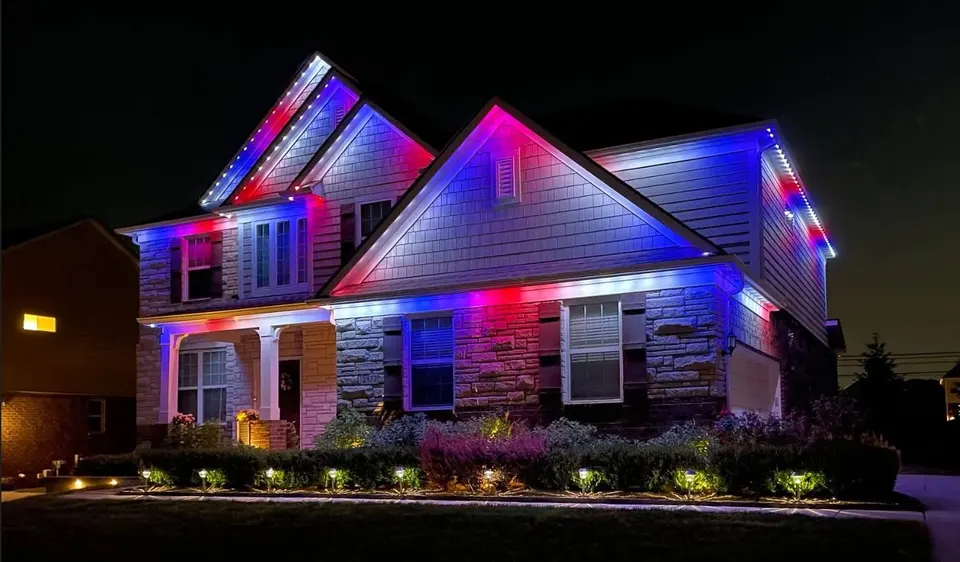
Permanent lighting is a decision about how your house looks throughout the year, including when the lights are off. Liberty Lights installs app-controlled LED roofline tracks color-matched to trim. For a Main Line home, start by deciding which architectural lines deserve emphasis and which should remain quiet. A front-only plan and a full-perimeter plan are different purchases, even when both use the same type of system.
Liberty Lights is based in Plymouth Meeting and serves the Main Line region; it does not have a separate branch in each community. Permanent installations start at $1,999, with the final price depending on roofline scope and access. Use the questions below to turn a broad idea into a quote that explains exactly what will be installed.
Choose the roofline that matters from your everyday viewpoints
Walk the route from your driveway to the front door, then look back at the house from a safe public viewpoint. Identify the eaves and peaks that make the building recognizable. A useful first design might include the main front roofline and a porch rather than every dormer, garage return and rear elevation. This is a homeowner planning example, not a description of a completed local installation.
For Wayne addresses near the Lancaster Avenue corridor, Radnor's planning context includes a mixed-use center along Route 30. That makes the actual viewpoint worth discussing: a roofline visible from a nearby sidewalk may need a different emphasis from one primarily seen across your own lawn. Do not assume that a Main Line address automatically calls for a large or elaborate layout.
Treat the unlit track as part of the exterior design
Color-matching the track to trim helps the permanent system relate to the house, but the right reference is the surface receiving the track. Send clear daylight photographs of the fascia, soffit and any contrasting trim. Explain whether repainting, gutter replacement or roof work is planned. Coordinating that information before installation can avoid designing around a finish that is about to change.
Ask how the proposed track line handles corners, changes in elevation and interruptions in the trim. A neat drawing should make those transitions understandable without relying on a nighttime photograph. If your Bryn Mawr or Villanova home has several trim colors, identify them separately rather than requesting one generic match. This is property-specific design guidance, not a claim about typical architecture throughout either community.
Discuss brightness and nearby windows before choosing effects
A roofline can be visually clear without becoming the brightest object on the block. Tell Liberty Lights where neighboring bedrooms, your own upstairs windows and shared outdoor seating face the proposed lights. Discuss available brightness controls and restrained color choices before deciding on a high-contrast effect. App control is part of the confirmed system; ask which specific settings the proposed installation supports rather than assuming every automation feature is included.
Consider both the front view and the side return. A short side section may face a neighbor more directly than the entire front elevation. If a property near Wayne's town-center streets has a close sidewalk viewpoint, judge the plan from that distance as well as from the driveway. Select a comfortable everyday setting separately from occasional celebratory colors, and agree on how to evaluate unwanted light spill.
Check who controls the exterior and which reviews apply
The Main Line name does not identify the approving authority. Tredyffrin lists Berwyn, Malvern and Wayne among its postal regions, illustrating why you should confirm the actual municipality for your address. If a homeowners association, condominium association, landlord or shared-ownership agreement governs the exterior, check its requirements before committing to visible tracks. Do not assume that a neighbor's lights establish permission for your property.
Historic status needs the same address-specific approach. Lower Merion's preservation guidance describes review of public-way-visible exterior changes when a building permit is sought in a locally regulated historic district. It distinguishes that status from National Register designation. For an affected Ardmore or Bryn Mawr property, ask the township about current parcel status and the proposed work; this guidance does not mean every permanent-lighting job requires historic review or a permit.
Make roof access and equipment space visible in the quote
Roofline length alone does not describe installation difficulty. A tall peak above a sloping yard, a narrow side passage or planting beds beneath the eaves can change the access plan. Photograph the ground below each proposed section, not just the house from the street. Include gates, fences and overhead wires, and explain where equipment could be positioned without using a neighbor's property.
Send information about the available power source and any existing exterior lighting equipment. Ask where the proposed system components and wiring would go and what access must remain available afterward. Do not assume that electrical changes, tree trimming or work on another owner's land are included. For a home with planned exterior repairs, clarify the order of work so the permanent track is not installed against an unresolved access or maintenance problem.
Compare the $1,999 starting price against a defined layout
The $1,999 starting price is a starting point, not a promise that every Main Line roofline costs the same. Request a written scope identifying included elevations, approximate covered lengths and access assumptions. If the full proposal exceeds your budget, ask for a front-focused alternative. Compare the difference in visible coverage instead of judging quotes solely by their headline totals.
Decide whether the garage, side returns and upper peaks contribute enough to justify including them now. For a Berwyn or Malvern address, the postal name itself explains neither the roof geometry nor the access cost. Supply the exact property details. If considering financing, use Liberty Lights' Acorn links to review the available information directly; do not treat the quote as a lending offer or assume approval, a rate or a payment amount.
Send a design brief and distinguish installation from repair
A productive inquiry includes your address, municipality if known, daylight front and side photos, preferred roofline coverage, trim colors and a working budget. Add a photo from the viewpoint that matters most. Explain whether you want understated everyday lighting, occasional color displays or both. If public photographs are not enough to show an access problem, describe that problem directly rather than leaving the estimator to infer it.
If you already have a third-party system, identify the brand and provide photos of the equipment and fault. Liberty Lights considers repairs only after assessment, and additions use its own system. The confirmed Wayne wire-strike repair is repair evidence, not proof of a new permanent installation. Likewise, the two Wayne warm-white Christmas displays illustrate seasonal roofline work, not permanent-track performance or authorization to service another manufacturer's warranty.
Looking for installation examples? See our documented regional projects. Photos are labeled with their actual towns; we do not present a nearby job as an installation in Main Line.
Local planning references
Geographic context is drawn from the sources below. Property permissions and current requirements must be checked for the actual address.